
Error
Working with Western Canadian farmers to protect canola crops from clubroot

By Dan Stanton, Corteva Agriscience Research Scientist
I have always admired small farming communities for their ability to pull together to solve a problem using a unique blend of hard work, cooperation and “can do” attitude.
As clubroot has spread across the Prairies in the past few years, I believe it has become one of those problems that we will all need to work together to manage and correct.
Your level of familiarity with clubroot likely depends on where in Western Canada you live. While it has been on the radar of farmers in Alberta for over a decade, many growers in Manitoba and Saskatchewan have only recently become aware of this serious soil-borne disease that has infested thousands of fields across our canola-growing regions.
- Leading in seed native trait development
- How clubroot affects your crop
- Preventing infestation
- A growing threat in Western Canada
- Rotating your crops
- Rotating your genetics
- Tips for proactive clubroot management
- A future without clubroot
- Brevant hybrids
Leading in seed native trait development
Brevant® seeds is one of two premium seed brands offered by Corteva Agriscience™, the company that introduced the first clubroot resistant hybrid back in 2009, and the only company currently offering a portfolio of CR hybrids with different sources of clubroot resistance. Thanks to Corteva’s industry-leading native (i.e. disease, drought and harvest management) seed trait development program, over the next few years we expect Brevant seeds will offer several more sources of CR to provide Western Canadian farmers with even more tools to address clubroot in canola.
Working out of the Corteva research station in Ardrossan, AB, I’m part of a team of global multidisciplinary scientists and team members devoted to identifying and incorporating new effective sources of resistance into our canola hybrids. While we have been making incredible strides on this front, as a company we recently realized that we needed to do more to educate farmers on clubroot, for it’s a problem that can’t be solved by science alone.
How clubroot affects your crop
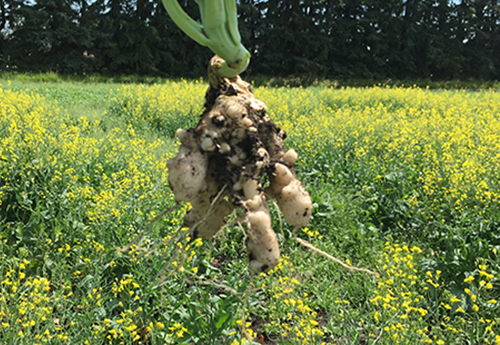
Clubroot Gall
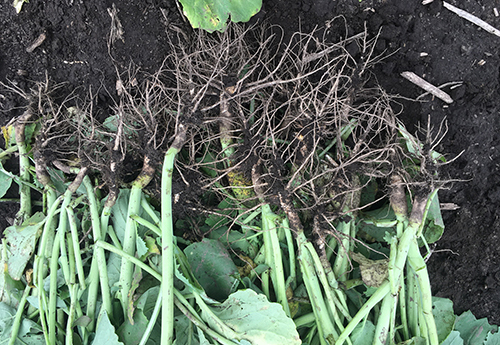
Healthy Canola Roots
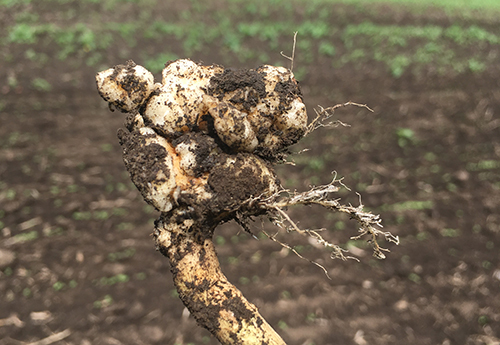
Clubroot Gall
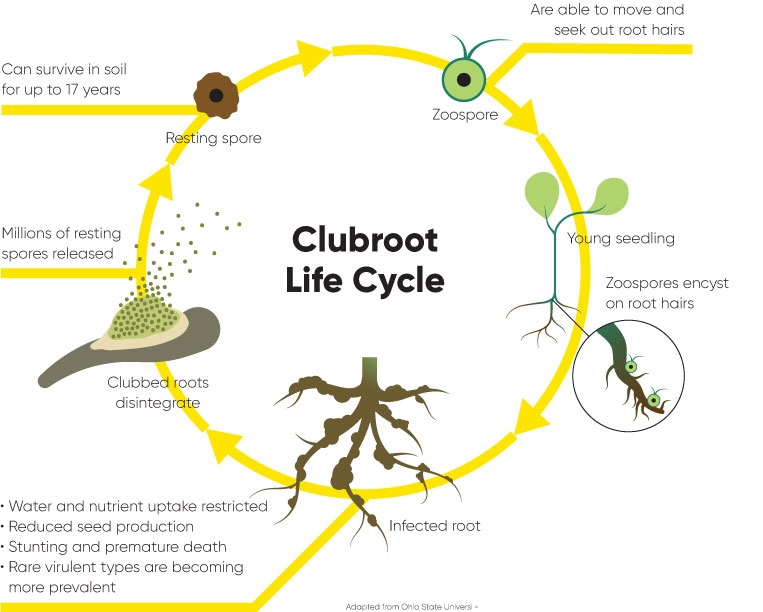
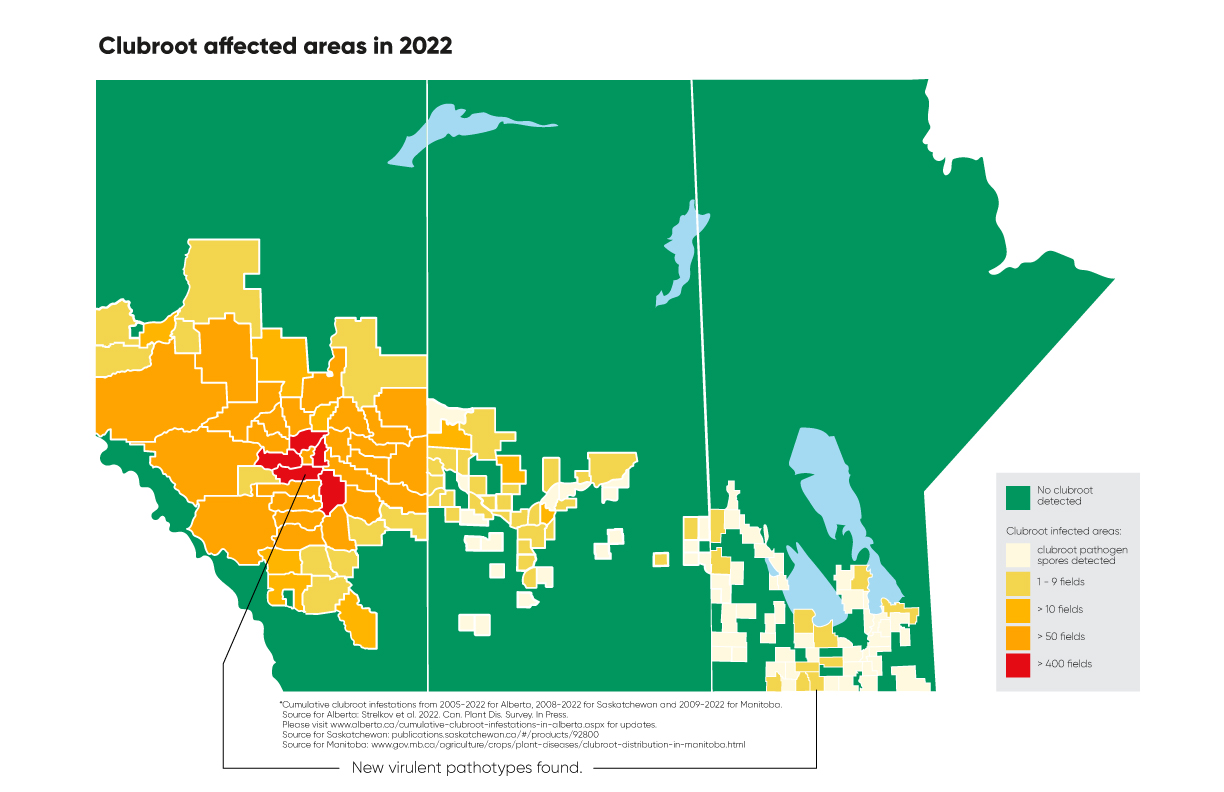
Caused by a fungal-like micro-organism, clubroot results in distinctive club-like/galling symptoms on the plant’s roots. Water and nutrient uptake is restricted, resulting in reduced seed production and, ultimately, stunted plant growth or plant death. It has been known to cause canola growers up to 100 per cent yield loss in extreme cases. While we have been able to develop new technologies and better methods to protect against clubroot, it continues to evolve, with new virulent pathotypes found in Alberta and Manitoba.
Clubroot infection releases millions of resting spores, which can survive in the soil for up to 17 years. Because of this long lifespan, reducing the spore population in your soil is key to long-term clubroot management. This is best achieved through a proactive, integrated approach that entails preventing infestation, rotating crops and rotating effective types of CR canola hybrids.
Preventing infestation
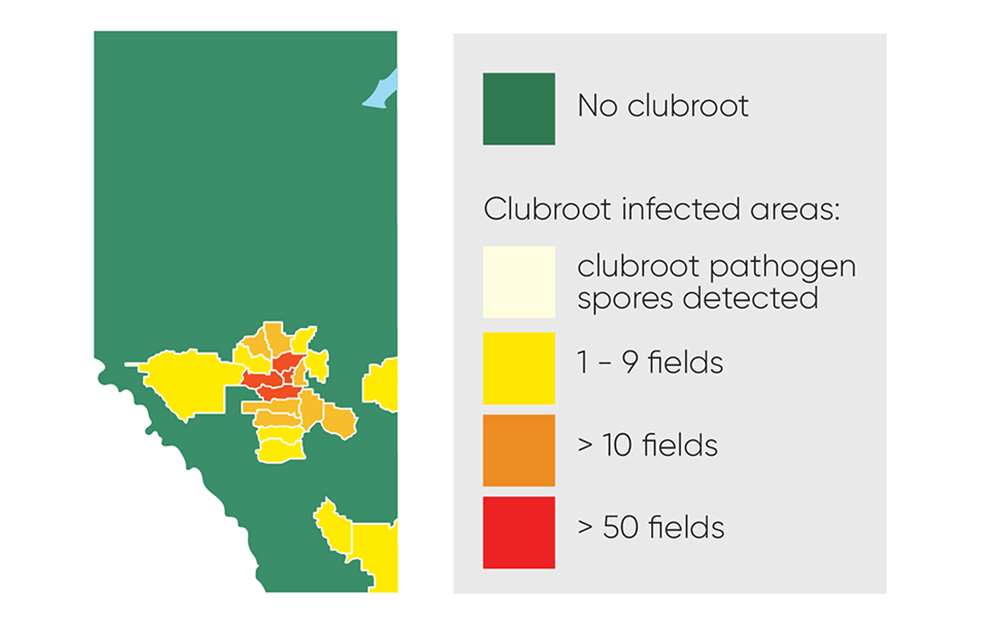
Clubroot is spread when infested soil is carried from field-to-field by farm machinery, wind, water erosion, etc. A 2022 map identifying clubroot-infested areas shows that the disease is now widely distributed across Western Canada’s canola growing regions. This means that even if clubroot symptoms are not evident in your fields, you should assume there's a diverse pathogen population nearby.
A growing threat in Western Canada
Thousands of infested fields have been identified across canola growing regions
Clubroot affected areas in 2011
Clubroot affected areas in 2022
If you’re in prevention mode, we recommend scouting your fields early and often. Also try not to move soil between and within your fields. This can be accomplished by practicing soil conservation, working infected areas last, and always disinfecting your equipment, vehicles and boots. If you notice symptoms of clubroot, patch management may be an option, if patches are small enough. You should also keep host weeds and volunteer canola in check, ideally within 3-weeks of their emergence. Finally, increasing pH (liming) may be an option in patches or field entrances as it has been proven to reduce infection, especially in dryer years.
More importantly, do not hesitate to deploy effective CR hybrids as it’s never too early to start protecting your crop from clubroot.
Even if you don’t have the disease in your fields, clubroot resistant hybrids are proven to significantly reduce spore propagation or disease establishment compared to susceptible hybrids. CR hybrids would help prevent any initial establishment of the pathogen. Better yet, Corteva Agriscience CR hybrids yield well and are agronomically solid.
Rotating your crops
The Canola Council of Canada recommends a minimum three-year crop rotation, yet many Western Canadian farmers continue to grow wheat and canola on a two-year cycle. Now, canola is obviously a big part of our agri-economy and likely essential to how you make your living, but as an industry we must also understand that the actions we take today will affect our tomorrow.
When you utilize a one-in-three canola rotation, 90 per cent of clubroot spores in the soil are broken down, so you reduce your spore loads over time. However, with a shorter rotation, high-resting spore loads increase over time, placing additional pressure on CR genetics.
If we continue to manage clubroot at a low level, we run the risk of eroding the genetic resistance that we're developing as an industry and it may impact the sustainability of canola as a crop.
Rotating your genetics
CR1 clubroot resistance refers to the resistance gene initially deployed by the industry in 2009. For the majority of growers in Western Canada who have not identified clubroot on their farm, CR1 is an excellent option and offers the maximum choice in products. However, if you have been using CR1 clubroot resistance, you may want to consider rotating to alternative CR sources. There is no reason to wait for CR1 to breakdown before rotating genetics, given that keeping spore load low is key to managing clubroot. A proactive approach is your best option.
If clubroot has been identified on your land or close by, the goal should be to not grow clubroot resistance genes more than once consecutively. There is a lot of genetic diversity in clubroot populations (37 identified pathotypes in Canada and counting), so essentially every time you grow the same resistance you may be increasing the number of rare virulent types. Whereas when you rotate resistance, you’re never allowing the same virulent pathotype to take hold. Therefore, to prolong the effectiveness of CR1, it is important to rotate to other CR gene sources, when possible.
At Corteva, we currently offer a portfolio of CR hybrids with different sources and combinations of resistance gene stacks. When you stack genes with each other, it creates a multiplying effect that creates a kind of layered resistance that avoids breakdown; the resistance genes are covering each other's backs so to speak.
Tips for proactive clubroot management
- Implement a 1-in-3 year crop rotation.
- Grow clubroot resistant canola hybrids.
- Prevent and minimize moving soil.
- Control host weeds and volunteer canola.
- Scout for signs of clubroot and look for virulence shift.
- Practice patch management.
- Control pH levels in soil with liming.
A future without clubroot
The goal of our native trait development program, in terms of clubroot, is to be able to provide stacks of effective genes, as well as products with single effective genes, that will allow growers to rotate between resistance, avoid new virulence problems and provide sustainable options for moving forward into the future.
Because Corteva has been leading the industry on this for quite some time, our production is coming to maturity, to the point where within the next few years we expect to release a number of different stacked gene resistance traits that growers can rotate as part of a proactive management strategy.
That’s undoubtedly great news for everybody in Western Canada’s canola farming community. But, it’s still important to remember that clubroot resistance is a finite resource that must be managed effectively through proper on-farm practices.
It is only by working together and taking a proactive management approach that we will succeed in defending our crops against clubroot.
Thank you for reading, and thank you for being part of the solution.
Brevant hybrids
Brevant seeds provides canola hybrids with proprietary Corteva Agriscience clubroot resistance technology. Here are our featured hybrids:
- 1028 RR is a high-yielding Brevant® seeds Nexera® canola hybrid with an outstanding disease package, including Clubroot (CR1) and Blackleg.
- Brevant® seeds B3012, is a canola hybrid containing both Clubroot (CR1) and Blackleg resistance along with excellent yield potential in the LibertyLink® herbicide tolerance system.
- Brevant® seeds B3014, is a canola hybrid with Sclerotinia, Clubroot (CR1) and Blackleg resistance - all in one, complete, high-yielding package. It is part of the LibertyLink® herbicide tolerance system.
- Brevant® seeds B3016 is a high-yielding, mid-maturity canola hybrid with a new source of Clubroot resistance (CR6), excellent early growth and Blackleg resistance
- NEW! Brevant® seeds Nexera® canola hybrid B3017N with the LibertyLink® trait, is high-yielding and early maturing. It is another canola hybrid from the Corteva Agriscience industry-leading clubroot development program that provides growers with a new source of Clubroot (CR7) resistance to both 3A and 3D pathotypes. And, it also includes strong adult-plant Blackleg resistance
- NEW! Brevant® seeds B4015 is a new, high yielding, Optimum® GLY hybrid with a new source of Clubroot (CR3) resistance along with strong adult plant blackleg resistance
Videos

Brevant - Clubroot Q&A Video
Brevant - Clubroot Q&A Video

Clubroot Infographic Video - Brevant
Stopping the spread of clubroot in Western Canada requires an integrated approach and partnerships with growers like you. Learn more at https://www.brevant.ca/en/seed/canola.html Products mentioned in this video may not be available in all areas. P
Clubroot Infographic Video - Brevant
Stopping the spread of clubroot in Western Canada requires an integrated approach and partnerships with growers like you. Learn more at https://www.brevant.ca/en/seed/canola.html Products mentioned in this video may not be available in all areas. P
Watch Corteva Research Scientist, Dan Stanton, answer the key questions about clubroot in Western Canada and how to protect your canola. In this video, you’ll get expert advice on the following:
- What is clubroot?
- Should Western Canadian farmers be concerned about clubroot?
- How can farmers protect their crops from clubroot?
- Why should farmers practice a 1-in-3 year crop rotation?
- Why is it important to rotate genetics?
- What is CR1?
- As new sources of clubroot resistance become available, should growers continue to grow CR1 or consider rotating resistance?
- If I don’t have clubroot on my farm, is it ok to grow Corteva/Pioneer/Brevant clubroot resistant hybrids?
- When should growers grow or rotate clubroot resistant hybrids?
- What is Corteva/Pioneer/Brevant doing to protect farmers against clubroot?
- Why is Corteva/Pioneer/Brevant partnering with farmers in the fight against clubroot?